
Editor’s note: This survey was fielded in February 2023. The findings below are a snapshot of the category at that early point and should not be read as current usage estimates.
In early 2023, media attention around ChatGPT raised an obvious question: who was actually using AI text generators, and for what? These tools use natural language processing and generation to produce text in response to a prompt. At the time, examples included ChatGPT, Frase, Copysmith, Google Bard, Hypotenuse AI, and Perplexity AI.
We surveyed more than 3,000 U.S. adults in February 2023 to find out who was aware of AI-based text generators, who had used them, and why. At that point, awareness was well ahead of familiarity and use.
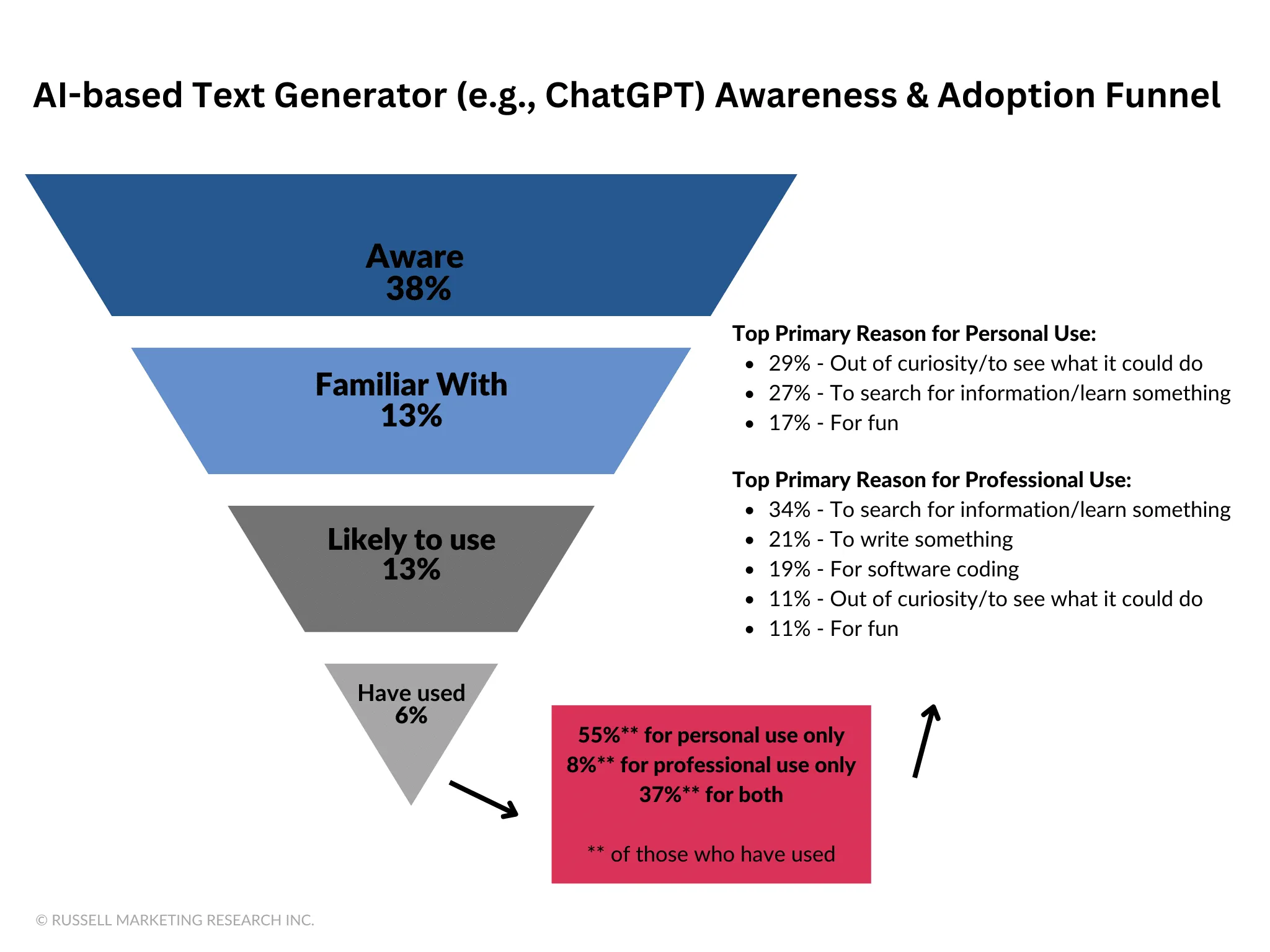
Read the AI text-generator chart data
Russell Research surveyed more than 3,000 U.S. adults in February 2023. The tables reproduce the chart's percentages. The reasons shown are the top primary reasons, not every response category; the chart does not report subgroup sample sizes.
| Stage | Share |
|---|---|
| Aware | 38% |
| Familiar with | 13% |
| Likely to use | 13% |
| Have used | 6% |
| Purpose | Share of users |
|---|---|
| Personal use only | 55% |
| Professional use only | 8% |
| Both personal and professional use | 37% |
| Reason | Reported share |
|---|---|
| Out of curiosity / to see what it could do | 29% |
| To search for information / learn something | 27% |
| For fun | 17% |
| Reason | Reported share |
|---|---|
| To search for information / learn something | 34% |
| To write something | 21% |
| For software coding | 19% |
| Out of curiosity / to see what it could do | 11% |
| For fun | 11% |
Awareness had grown quickly
Thirty-eight percent of respondents were aware of these tools. That was about half the share aware of virtual reality or cryptocurrency in the same survey.
A much smaller group (13%) considered themselves familiar with AI-based text generators rather than simply aware of them.
A minority planned to use the tools
About 13% of respondents said they were open to and likely to use AI-based text generators. That was roughly the same share that said they were likely to use cryptocurrency in the same survey.
Use remained limited and curiosity played a role
Only 6% of respondents had used an AI-based text generator, equal to 16% of those who were aware. Among users, 55% had used one only for personal purposes, 8% only for professional purposes, and 37% for both.
At that early stage, much of the personal use was exploratory. About 29% had used a tool to satisfy their curiosity, 17% for fun, and 27% to search for or learn something.
Among respondents who had used a text generator for business, 34% had used one to search for or learn something, 21% to write, and 19% for software coding. Curiosity and fun each accounted for 11%.
Early use skewed toward familiar technology-adopter groups
Every stage of the funnel skewed slightly toward adults under 55, college graduates, and people on the West Coast—groups that often adopt new technology earlier.